import numpy as np
import matplotlib.pyplot as plt
from scipy.ndimage import gaussian_filter
from skimage import data
from skimage.transform import resize1.1.6. Cold-Diffusion (CD)
Another diffusion paradigm is the Cold-Diffusion (CD) (Bansal et al. 2023) generalization. Although previous formulations specifically employed noise addition as the degradation scheme, CD showed that more general degradation operators could be used to train Diffusion Models (DMs).
Let \(\boldsymbol x_0 \in \mathbb R^n\) be a data point sampled from \(\boldsymbol x_0\sim p_0\) and let \(\boldsymbol x_t = \boldsymbol D (\boldsymbol x_0, t)\) be the degradation of \(\boldsymbol x_0\) by the degradation operator \(\boldsymbol D : \mathbb R^{n \times 1} \to \mathbb R^n\) at scale \(t\). Then, let \(\boldsymbol R_{\boldsymbol \theta} : \mathbb R^{n \times 1} \to \mathbb R^n\) be the restoration operator that satisfies: \[ \boldsymbol R_{\boldsymbol \theta} \left(\boldsymbol D (\boldsymbol x_0, t), t\right) \approx \boldsymbol x_0. \tag{1}\] That is, the restoration operator is a neural network parametrized by \(\boldsymbol \theta\). This network can be trained minimizing the following objective: \[ \mathcal L(\boldsymbol \theta) = \mathbb E_{\boldsymbol x_0, t} \left\| \boldsymbol R_{\boldsymbol \theta} \left( \boldsymbol D(\boldsymbol x_0, t), t \right) - \boldsymbol x_0 \right\|, \tag{2}\] where \(\boldsymbol x_0 \sim p_0\) and \(t\) is sampled from a degradation scale interval.
The CD formulation is particularly interesting for inverse problems, as the degradation and restoration operators can be directly employed during the DM training.
Code
Importing the packages.
Loading a data example.
x_0 = data.astronaut().astype(np.float32) / 255.0
num_steps = 5
timesteps = np.linspace(0, 1, num_steps)
Creating degradation schemes.
def degrade_blur(x, t, max_sigma=15.0):
    sigma = t * max_sigma
    if sigma == 0: return x
    return gaussian_filter(x, sigma=(sigma, sigma, 0))

def degrade_pixelate(x, t, min_res=4):
    if t == 0: return x
    h, w, c = x.shape

    curr_h = max(min_res, int(h * (1 - t) + min_res * t))
    curr_w = max(min_res, int(w * (1 - t) + min_res * t))

    downsampled = resize(x, (curr_h, curr_w), order=0, anti_aliasing=False)
    return resize(downsampled, (h, w), order=0, anti_aliasing=False)

def degrade_mask(x, t):
    if t == 0: return x
    h, w, c = x.shape
    mask_size_h = int(h * t)
    mask_size_w = int(w * t)

    start_y = (h - mask_size_h) // 2
    start_x = (w - mask_size_w) // 2

    x_t = x.copy()
    x_t[start_y:start_y+mask_size_h, start_x:start_x+mask_size_w, :] = 0.5
    return x_t
Plot the degradation schemes.
fig, axes = plt.subplots(3, num_steps, figsize=(12, 6))
plt.subplots_adjust(wspace=0.05, hspace=0.1)

for i, t in enumerate(timesteps):
    blur_t = degrade_blur(x_0, t)
    pix_t = degrade_pixelate(x_0, t)
    mask_t = degrade_mask(x_0, t)

    axes[0, i].imshow(blur_t)
    axes[0, i].axis('off')
    if i == 0: axes[0, i].set_title(f"t={t:.2f}", fontsize=12)
    else: axes[0, i].set_title(f"t={t:.2f}", fontsize=12)

    axes[1, i].imshow(pix_t)
    axes[1, i].axis('off')

    axes[2, i].imshow(mask_t)
    axes[2, i].axis('off')

axes[0, 0].text(-0.2, 0.5, 'Blur', va='center', ha='right', transform=axes[0, 0].transAxes, fontsize=14)
axes[1, 0].text(-0.2, 0.5, 'Pixelate', va='center', ha='right', transform=axes[1, 0].transAxes, fontsize=14)
axes[2, 0].text(-0.2, 0.5, 'Mask', va='center', ha='right', transform=axes[2, 0].transAxes, fontsize=14)

plt.show()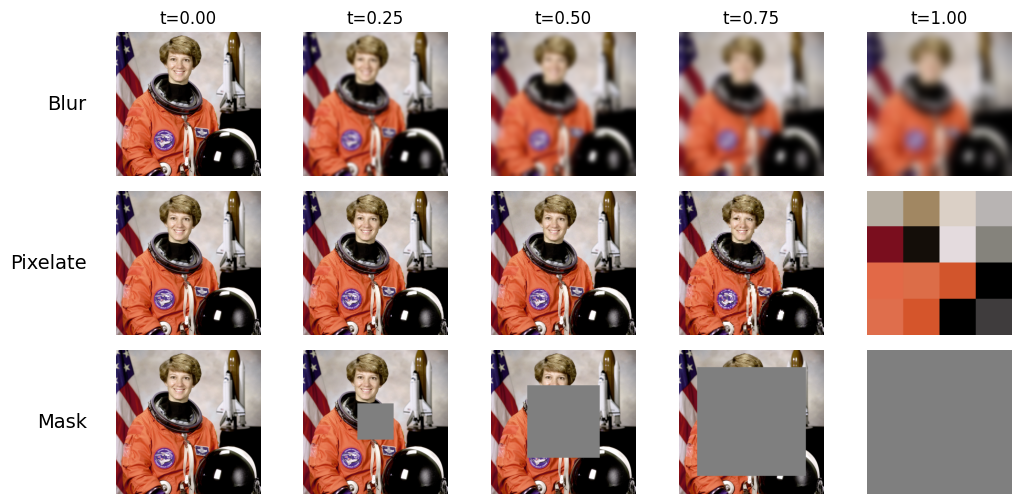
References
Bansal, Arpit, Eitan Borgnia, Hong-Min Chu, Jie Li, Hamid Kazemi, Furong Huang, Micah Goldblum, Jonas Geiping, and Tom Goldstein. 2023. “Cold Diffusion: Inverting Arbitrary Image Transforms Without Noise.” Advances in Neural Information Processing Systems 36: 41259–82.